English | 日本語
How an Elixir function becomes a circuit, inside. It assumes Elixir and the basics of
digital circuits (clocks, registers, combinational logic); what can be written is in the
reference (EHLS.defhls/2, EHLS.Pipeline).
The whole flow
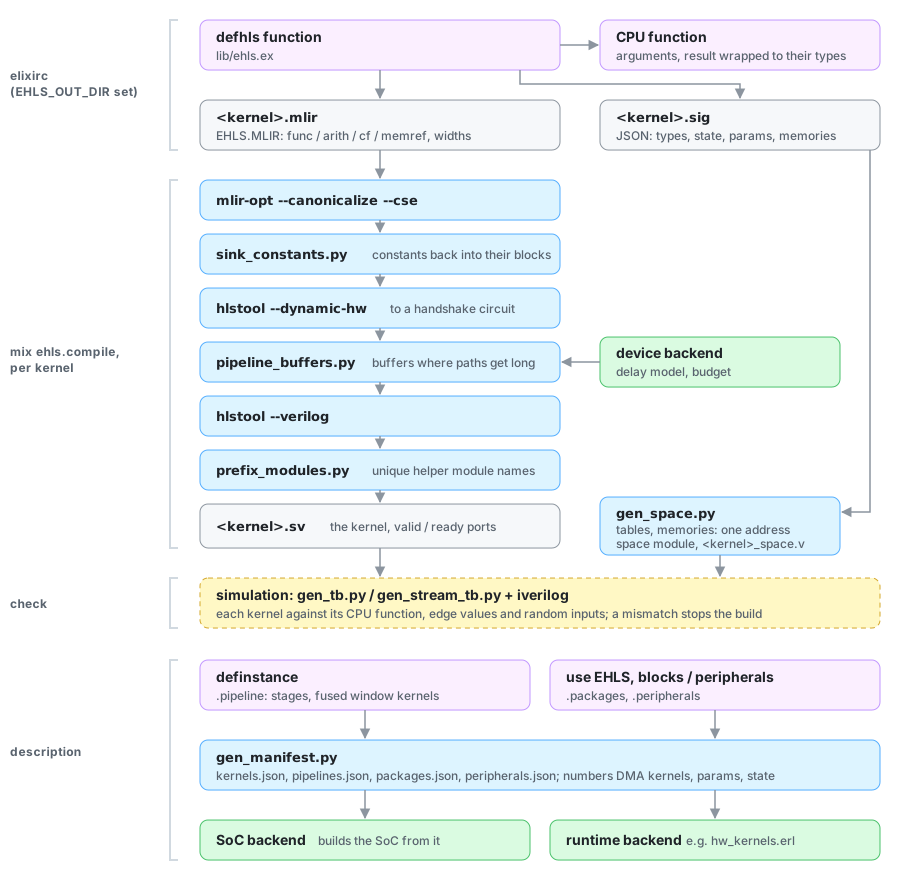
Four steps; calling from the CPU comes last:
- While Elixir compiles, each
defhlsfunction is written as MLIR. mix ehls.compileturns the MLIR into circuits (SystemVerilog) with CIRCT.- Every circuit is simulated against its Elixir function.
- The instances become a description for the SoC and runtime backends.
1. From an Elixir function to MLIR
defhls (lib/ehls.ex; its work in lib/ehls/compiler.ex) is a macro. From a function definition it makes two things:
- The CPU function: the body, kept as an Elixir function, with the arguments and the result cut to their declared widths. A circuit holds values only in the widths declared, so the CPU computes in the same widths and both give the same results.
- Processed at the end of the module:
defhlsanddefinstanceonly note the definition, and@before_compiledoes the work, to bring a function's clauses together and make callees before their callers. case,cond, several clauses: for the circuit they become nestedifs on the AST (lib/ehls/syntax.ex). The CPU function stays as written.- Expanding calls: a call of another
defhlsis replaced by its body on the AST, before the translation to MLIR (lib/ehls/inline.ex). Arguments and result go throughsigned/unsigned, variables get names per call. Constants stay constants, so shifts and table reads by them are still wiring after the expansion. - The circuit's source: with
EHLS_OUT_DIRset at compile time, the body translated to MLIR in<kernel>.mlir(EHLS.MLIR), and its types, state, levels and memories as JSON in<kernel>.sig, which the later steps and the target read to know the kernel's inputs and outputs.
MLIR, a project of LLVM, is a framework for building compilers' intermediate
representations, with "dialects" (sets of operations) for different purposes. Elixir HLS uses
only standard ones: func, arith, cf and memref. Arithmetic and bit operations are
arith; an if without a loop inside computes both sides and selects (arith.select),
loops and the ifs around them are branches of cf; memories and tables are memref.
Widths follow from the operations: + widens by one bit, * to the sum of both widths, so
that nothing overflows on the way; the function's result is then cut to its declared type,
as the CPU function does.
2. From MLIR to a circuit (CIRCT)
CIRCT, built on MLIR, is a compiler infrastructure for circuits. Elixir HLS makes the circuits
with its hlstool --dynamic-hw. In this style (dynamic scheduling) every value carries valid
and ready signals and moves when its receiver is ready: a function with loops and branches
becomes a working circuit without deciding beforehand what is computed in which clock, at
the cost of the handshake logic.
mix ehls.compile (priv/hls_compile.sh) takes each kernel through:
mlir-opt --canonicalize --cse: MLIR's standard clean-up: constant folding, repeated computations removed.sink_constants.py: the clean-up moves all constants to the function's start; in a dynamically scheduled circuit a constant used after a loop is then carried through the loop like a variable, on every iteration. The constants go back next to their uses.hlstool --dynamic-hw: to a handshake circuit (still as MLIR).pipeline_buffers.py: where a handshake circuit has no register (buffer), a value passes the combinational logic within one clock; a long path misses the clock. CIRCT buffers either almost nothing or every channel: with the first a de-emphasis filter became 28 levels of logic and missed 50 MHz, the second costs a great many registers. So the delay of each operation is estimated, and buffers go only where a path exceeds the budget; the estimates and the budget come from the device backend (EHLS.Device,DELAY_MODEL/PIPE_BUDGET). The loop buffers are made one slot deep as well, for fewer clocks per iteration.hlstool --verilog: written out as SystemVerilog.prefix_modules.py: CIRCT names its helper modules after their operations, the same in every kernel, so they collide when one SoC holds several kernels; they get the kernel's name as a prefix.
A kernel's tables and memories become one address space module (<kernel>_space.v,
gen_space.py), because hlstool of CIRCT 1.160 handles one memory (memref) per kernel. Its
reads come out one clock later, so that the FPGA tools can use block RAM.
3. The simulation check
Every kernel is simulated with iverilog and compared with its CPU function (gen_tb.py,
gen_stream_tb.py), on edge values (0, the largest values, around the sign) and random
inputs; a kernel with state gets one stream from its initial state, restarted once halfway.
A single difference stops the build. The inputs and the testbenches in detail: the documentation of
mix ehls.compile (mix help ehls.compile).
The CPU function is the specification, so a circuit that passes has been shown to do what the specification says.
4. Instances and the description for the target
definstance (lib/ehls/compiler.ex, lib/ehls/pipeline.ex) maps each stage to a defhls function of the module or to
a block (EHLS.Blocks). chunk_every(n, k, :discard) |> map(&f/1) becomes one kernel, with
a ring buffer of the last n items and a counter: the first chunk once n have come, then one every k.
- An instance of values (arguments with types, lib/ehls/level.ex) is one kernel of its body, behind hls_level_adapter.v: the CPU writes the arguments' words, a start write takes them all in one clock, and the result is held with the count of the start it is for.
- An instance of streams is built as a graph from its body: every join made explicit
(
zip_with(a, b, &f/2), lib/ehls/join.ex), each pipe between joins made stages, the joins and the forks (a stream named and used twice) linked between them. A function placed with levels (map(&f(&1, k_hw(:value)))) becomes a generated kernel of one argument, its levels wired. A join is the compiler's blockhw__zip(then a generated kernel of the pair), a forkhw__fork; another instance called in it is acallstage. - A function with its state is placed where it is written with
transform(init, &f/2): a kernel made there,f__s…, its second argument the state, in registers behind hls_state_adapter.v, loaded withinitat the start. A tuple in the state is registers too,elem/put_elemwith a variable index selects. Placed withmemory: [:hist], the tuplehist(lib/ehls/tuple_state.ex) becomes a memory argument of a kernelf__m_hist:elemits reads,put_elem's writes done at the end of the step, after every read of it, and the rest of the state the kernel's state. The memory is a region of the kernel's memory space (priv/gen_space.py), zero-filled at the start. Named,transform(..., memory: [:hist], name: :f), the CPU reads the state whole withinst(:state, :f): the values as any named state's (peek), each memory word by word through the memory space's CPU port (the SoC'smem_addr/mem_data, first in its next clock, the kernel waiting that one clock), each word as it is when read. - An agent (
EHLS.Agent) is one register (hls_litex.pyAgent) its functions' adapters share (SHARED): each takes the state in and gives its next value, one function at a time, in turn among those that have an element.
The instance's structure goes into .pipeline (JSON): its stages; the links between them, each with its kind, type,
and the input of the stage it goes into (port) and the output it comes from (from_port, a fork's); its inputs
from the CPU, each with the stage it goes into; its output (output_from); for an instance of values, level. The
peripherals of use EHLS, peripherals: [...] go into .peripherals.
priv/gen_manifest.py then collects them, with every kernel's .sig, into kernels.json,
pipelines.json, packages.json and peripherals.json. There the description is put together across modules: the
kernels' levels wired to instances of levels or pins, an instance called in another wired to it (wired: its
input and output no CPU ends), each checked (in the build, the types, called once, no loops). It numbers the
instances of levels, the state words (a hold stage's word among them), the CPU ends and the packages' registers. The SoC backend builds the SoC from this description; the runtime backend
generates what the CPU side needs to call the circuits by the same numbers (AtomVM: the Erlang
module hw_kernels with the indices).
5. The CPU ends
An instance's argument, and a stream left at its end, are its CPU ends. What the design turns on is that a transfer goes on after its NIF has returned: meanwhile a garbage collection can move the calling process's heap, and other processes must keep running.
- Circuit (
CPUIn,CPUOutin hls_litex_blocks.py): one LiteDRAM DMA engine per end. The engines share one crossbar port to read and one to write (SharedPort), taking turns per command, so the crossbar does not grow with the ends. An engine only asks for what it can finish (a reader has reserved room for the data, a writer already holds it), so an end standing still, a slow source or an output nobody reads, holds up no other; a FIFO of whose each command was routes the data. A signalfinishedsays it is over: for an input when the last word has left the DMA, for an output when the last word has gone towards the SDRAM.done(all read requests issued) is too early for an input, as disabling the DMA flushes its FIFO.buffer:is a block RAM FIFO before the output's DMA. - Interrupt and message (src/hwstream_nif.c):
finishedrising is an event per end, on one interrupt. The interrupt only hands over to the system work queue, which sends the message (as the event queue does). The work readsfinishedagain, so that a late interrupt of a cancelled transfer is not taken for the next one. - Memory: an output goes into a refc binary the driver holds, handed over in the message. An input stays in place if it is a refc binary, aligned and in SDRAM, with one more reference; anything else (small, a literal in flash, misaligned) is copied first. The CPU's D-cache is write-through, so only an invalidate is needed after an output's transfer.
- The next transfer: while one is in flight an end takes one more (
end_send,end_request), which the interrupt's work starts as soon as the first is done, so a stream goes on without waiting for the program; beyond that the answer is busy. - One element without DMA (
f(:send, :x, v)): its packed words go into the input end's small FIFO (end_push), in front of the DMA, from the NIF itself; no message follows. - Events: the publishers' events go into one queue in the FPGA, in order, with their times. Its interrupt drains it into a
ring in the NIF, and the work queue sends each event to its topic's subscribers (up to 4 per topic): every one, or with
active:the next n, the ones after kept (16 at most) until asked again. - Calls that wait (lib/ehls.ex):
f(bin)and the like are Elixir code asking for the same transfers and waiting in areceive, so only the calling process waits. On a timeout they cancel and drop what may be on its way.
When stopping, a kernel finishes the element it has begun, its outputs dropped: otherwise that element would come out after the start, from the old state. Once the kernels have let go, the links and the buffer are emptied.
6. On the CPU
An instance placed on the CPU (on: :cpu, or no FPGA) is not a circuit:
- An instance on the CPU (lib/ehls/cpu_instance.ex): a process, registered under the instance's key, that holds each
function's state between calls and runs the functions over the list it is given. A
tickssource runs on a timer. - As machine code (
cpu: :nif): the functions run as C instead of Elixir. lib/ehls/nif.ex writes each kernel's C from its MLIR (mix ehls.compile --target cpu, checked against the function on the host); the runtime backend builds them into the NIFshwnif(src/ehls_nif.c), andEHLS.NIFRuncuts a long input into chunks so that the VM's other processes keep running between calls. - One function of an instance on the CPU (
map(&f/1, on: :cpu), lib/ehls/cpu_stage.ex): the instance is cut there: the part before becomes<name>__pre, a circuit ending in a CPU end, the part after<name>__post, a circuit starting at one, andEHLS.CpuDriver(a process) takes the stream from the one, through the function's NIF, to the other. Its levels are read by the driver before each batch. - EHLS.Server (lib/ehls/server.ex): a GenServer owning an instance: it starts and stops it with the application, calls it for its callers in turn, and hands the events of its topics on to any number of processes.
Backends
What depends on the hardware is in three kinds of backends: device, SoC and runtime.
| kind | backend | module | files (priv/backend/) | what it does |
|---|---|---|---|---|
| device | generic | EHLS.Device.Generic | — | delay estimates and budget for pipeline_buffers.py |
| device | gowin_gw5a | EHLS.Device.GowinGW5A | gowin/ | delay estimates and budget; check_timing.py (Gowin's timing report), gowin_litex.py (LiteX toolchain settings for Gowin, the constraint for a pin's pull) |
| SoC | litex | EHLS.SoC.LiteX | litex/ | hlslitex.py: instances with registered links (a FIFO before a time-multiplexed kernel), instances of levels, levels wired into kernels and state through CSRs (`hwstream*), the block packages' Python modules; built-in blocks in hls_litex_blocks.py (EHLS.SoC.LiteX.Blocks);EHLS.GPIO`'s circuit in ehls_gpio.py |
| runtime | atomvm | EHLS.Runtime.AtomVM | atomvm/ | the :hwstream NIFs (src/hwstream_nif.c) and their stubs, the CSR headers (gen_csr_header.py), hw_kernels.erl (gen_hw_kernels.py); needs litex |
EHLS.Backend picks one of each kind per build (EHLS_DEVICE / EHLS_SOC / EHLS_RUNTIME or
the config) and checks that they combine; use EHLS also checks that every block
package is for the SoC backend in use. Without a runtime backend (the default) defhls /
definstance generate only the CPU functions.